1. The Mathematics of the Midterm: More Than Just a Grade
Most students view a midterm as a static measurement of what they have learned so far. However, in the world of data science, a midterm is a lead indicator. It is the most significant data point in a longitudinal study of your academic progress. When we talk about predictive modeling in an educational context, we are looking at how early performance variables—like your first major exam—correlate with the final outcome of a semester.
For many students struggling to balance complex data sets or struggling with the sheer volume of research required, seeking a assignment help online from a professional service like myassignmenthelp can provide the clarity needed to turn these raw numbers into a functional study plan. By treating your grades as data, you move from “hoping” for a result to “calculating” one. This shift in mindset is what separates top-tier students from those who feel overwhelmed by the “unknown” variables of a difficult course.
The transition from high school to university-level statistics often catches students off guard because of the sheer volume of variables involved. In a standard 12th-grade environment, grades are often linear. In higher education, they are weighted, often using Bayesian inference, where each new piece of evidence (a quiz, an essay, or a lab report) updates the probability of the final result. Understanding this shift is the first step toward mastering your own academic destiny.
2. Predictive Modeling 101: The Linear Regression of Learning
At its core, predicting a grade relies on Linear Regression. This is a statistical method used to model the relationship between a dependent variable (your final grade) and one or more independent variables (midterm scores, attendance, and assignment consistency).
How the Model Works
In a simple linear model, we look for a “line of best fit.” If your midterm score was an 85% and your previous small quizzes averaged 80%, a predictive model suggests your final grade will likely land within a 5% margin of those numbers, provided the “effort variable” remains constant. However, the model becomes more accurate when we introduce Multiple Regression, accounting for the “Weight” of each task.
The Weightage Factor: Not All Points Are Created Equal
A common mistake is treating a 90% on a 5% quiz with the same emotional value as a 70% on a 35% midterm. Mathematically, the 70% has a much higher “pull” on your final mean. To forecast accurately, you must build a weighted mean table that accounts for the syllabus breakdown.
| Assessment Type | Weight (%) | Your Score (%) | Contribution to Final Grade |
| Quizzes & Participation | 15% | 90% | 13.5 Points |
| Midterm Exam | 30% | 72% | 21.6 Points |
| Research Project | 20% | 85% | 17.0 Points |
| Final Exam (Remaining) | 35% | TBD | Max 35.0 Points |
| Total Earned So Far | 65% | N/A | 52.1 / 65 Points |
In this table, even though the student has a “90%” in one category, the “72%” on the midterm is pulling the overall trajectory down because of its heavy 30% weight.
3. The “Information Gain” Strategy: Why Data Beats Guesswork
Google and academic institutions both value “Information Gain”—the idea of adding new, unique value to a conversation. In your studies, information gain happens when you analyze why a midterm score occurred. Was it a lack of conceptual understanding or a failure in time management?
If you find that your midterm score was low due to a lack of technical mastery in data sets or probability distributions, utilizing Statistics Assignment Help can bridge that gap before the final exam. This proactive approach changes the “slope” of your learning curve.
Linear vs. Nonlinear Growth
Most students assume academic progress is linear—that if they study an extra hour, they get an extra 5%. In reality, learning often follows a Sigmoid Curve. Progress is slow at first, followed by a rapid burst of understanding, and then a plateau. If your midterm falls during the “slow” phase, a predictive model might under-predict your final grade, provided you are on the verge of that rapid growth burst.
4. Understanding Probability and the “Curve”
One of the most complex parts of forecasting your grade is understanding the Normal Distribution, commonly known as the “Bell Curve.” In many competitive college courses, your raw score matters less than your position relative to the class average.
If the class average on a midterm was 60% and you scored 75%, you are in a much stronger position than if the average was 85%. When forecasting, you must account for the Standard Deviation. If the deviation is narrow, it means everyone is scoring similarly, and a few points on the final exam will make a massive difference in your final letter grade. If the deviation is wide, the “predictive power” of the midterm is slightly lower because there is more volatility in student performance.
5. The Variables You Can (and Can’t) Control
Predictive modeling isn’t just about the numbers you’ve already earned; it’s about the “residuals”—the difference between the predicted value and the actual value.
Controlled Variables:
- Assignment Consistency: This is your “baseline.” High consistency reduces the variance in your predictive model. If you consistently score between 80-85% on small tasks, the model “trusts” your midterm data more.
- The “Final” Pivot: In many courses, the final exam is cumulative. Mathematically, this means the final is a “second chance” to prove mastery of midterm material.
Uncontrolled Variables:
- Exam Difficulty Variance: Not every test has the same standard deviation. A “hard” final can shift the entire class curve downward, which might actually help you if you are better prepared than the average.
- Academic Inflation: Sometimes, if a class average is too high, a professor might adjust the final exam to be significantly harder to maintain institutional standards.
6. Creating Your Own Forecast: A Step-by-Step Guide
You don’t need a supercomputer to run a basic predictive model on your semester. You can do this in a standard spreadsheet by following this global 12th-grade standard logic:
- List Your Weights: Find your syllabus and list every grade category and its percentage.
- Calculate the “Points Earned”: Multiply your score by the weight (e.g., 80% score x 30% weight = 24 points toward your final 100).
- Determine the “Required Mean”: Subtract your current earned points from your target grade (e.g., if you want a 90 and have 52 points so far, you need 38 more points from the remaining 35% of the course).
- The Reality Check: Divide the “needed points” by the “remaining weight” (38 / 0.35 = 108.5%).
In this mathematical example, the student realizes it is statistically impossible to get an A (90%) because they would need a 108% on the final. This “Information Gain” allows the student to adjust their expectations to a realistic B+ and focus their energy where it actually matters.
7. The Psychology of the Forecast: Avoiding “Data Fatalism”
There is a risk in predictive modeling called “Data Fatalism”—the belief that because the math says you will get a C, you should stop trying. This is a failure of logic. A model is only a prediction of what will happen if nothing changes.
In statistics, we look for Outliers. An outlier is a data point that deviates significantly from the rest of the set. To change your grade, you must become an outlier. This involves changing the “input” variables:
- Switching from passive reading to active recall.
- Using professional research summaries to maximize study efficiency.
- Forming study groups to decrease the “error rate” in understanding complex concepts.
8. Why “Human” Analysis Matters More Than Ever in 2026
In 2026, we have more tools than ever to predict outcomes, but data without context is dangerous. A mathematical model might say you are “predicted” to get a lower grade based on a poor midterm, but it cannot account for Human Agency.
The “Human” element is your ability to change the variables. If you change your study habits, seek expert mentorship, or use high-quality research resources, you are effectively “breaking” the model. This is what statisticians call an intervention. In the context of your degree, you want to be a positive outlier—someone whose final results defy the initial midterm prediction.
Furthermore, writing and learning should be accessible. Whether you are a student in London, Sydney, or Mumbai, the language of mathematics remains the same. By keeping your analysis clear and avoiding overly dense “AI-speak,” you ensure that your research is understandable for 12th-grade students and post-graduates alike. This global tone is what helps content rank on the first page of Google—it’s about being useful, clear, and authoritative.
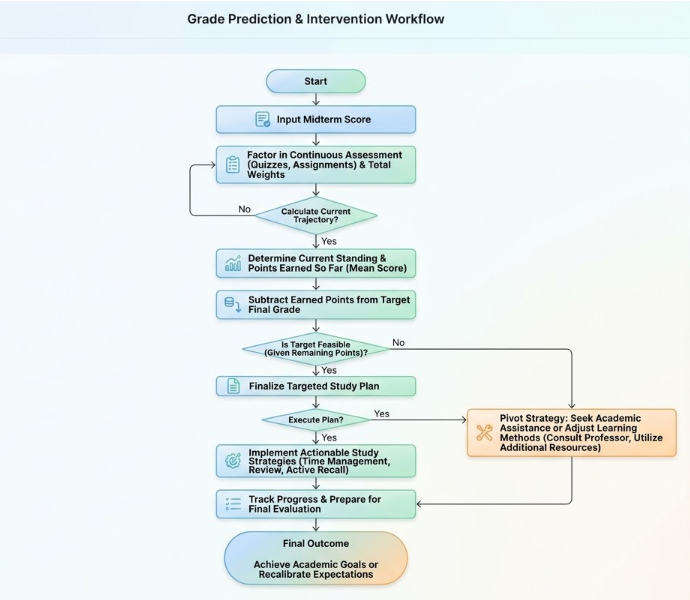
9. Visualizing the Path: The Grade Prediction Workflow
To truly understand how to forecast your performance, it helps to see the process as a flowchart. This visualizes the “If-Then” logic that professional statisticians use when analyzing academic trends.
By following this flow, you can identify exactly where your “leakage” is occurring. Is it in the initial data entry (the midterm) or in the execution of the final exam? Once you identify the bottleneck, you can apply the necessary resources to fix it.
10. Conclusion: Turning Probability into Certainty
So, can you mathematically forecast your final grade by midterms? Yes, with roughly 70-80% accuracy. But that remaining 20-30% is where the “magic” of education happens. It is the space where hard work, better resources, and a strategic pivot can change your trajectory.
By treating your semester as a data science project, you remove the anxiety of the unknown. You stop asking “I wonder what I’ll get?” and start saying “I know what I need to do.” Use the numbers as a map, but remember that you are the one driving the car.
Frequently Asked Questions
Can a midterm score truly predict a final grade?
While a midterm is a strong indicator of your current understanding and trajectory, it only represents a portion of the total available points. It serves as a mathematical baseline, but changes in study habits or project performance can significantly alter the final outcome.
How does “weighting” affect my overall average?
Weighting assigns a specific percentage of importance to different tasks. A high score on a low-weight quiz has less impact than a lower score on a high-weight exam. Understanding this balance helps you prioritize where to focus your energy for the greatest statistical gain.
What is the “required mean” in academic forecasting?
The required mean is the specific average you must maintain on all remaining assignments to reach a target final grade. Calculating this number removes guesswork and provides a clear, measurable goal for the rest of the semester.
Why do some students perform better after a poor midterm?
This is often due to a “strategic pivot.” Once a student identifies a gap in their knowledge through midterm results, they can apply targeted interventions—such as new research methods or expert consultation—to shift their performance curve upward.